Multi-Generational Planning

This article originally appeared in the January 2026 edition of the Irish Broker magazine.
In May 2025 Brokers Ireland, in association with Irish Life, hosted a symposium from eight broker networks from around the world under the headline theme of ‘The Value of Advice’. A range of themes relating to financial planning and advice were discussed, with the industry experts in each country identifying what's working, what's changing and what clients in their countries perceive as valuable.
Eamonn Twomey from StepChange subsequently interviewed Rachel McGovern, Deputy CEO of Brokers Ireland, and Anthony Kavanagh, Director of Brokerage at Irish Life to find out what were their key takeaways from the symposium.
Eamonn: Multi-generational planning is seen as one of the key areas of financial planning of the future and was a really big topic of conversation at the Symposium. Can you give us a sense of why it's seen as so important?
Anthony: It was one of the things that really shone through at the symposium was just the sheer interest in the multigenerational transfer issue that's going to happen over the next number of years.
And I think George Dell, Director & Chair, Financial Intermediaries Association of Southern Africa, highlighted it when he was able to show that 70% of assets in the South African market are lost on wealth transfer.
Wealth transfer in Ireland is something relatively new. Over the last number of years, we've seen significant growth since the great financial crisis we're now starting to see that the baby boomers are starting to transfer those assets across.
It has been coming through in the property market over the last number of years in terms of people transferring property assets but now we're going to start to see significant pension and investment assets transfer through. The planning, the advice and the incorporation of the younger generations into the financial planning world for advisors is going to become fundamental.
So, I think that was one of the key topics that for me was the importance of managing that transfer because you can't, as an advisor, assume that just because I had a good relationship with the asset owner today, when that asset is transferred on, that I'm going to maintain that relationship.
It's going to require work, and it does require planning.
Eamonn: We heard at the symposium how this is playing out in practice around the world. Can you give us a sense maybe of some of the different forms this multi-generational planning is taking?
Rachel: Advisers are now being trusted to start wealth across multiple generations and they're doing this in a number of different ways, and it involves structured plans, it involves family meetings, it also involves succession planning, estate planning, onboarding of heirs and it also involves educating younger family members.
The ‘Bank of Mum & Dad’, we heard, is the fifth largest lender in Australia and also is significant in Ireland too, especially for house purchases.
But I suppose the important thing there is to remember that parents don't put their financial future at risk when they're looking at passing on their wealth.
Eamonn: My own financial broker has been very clear about the importance of having family meetings and even with teenage children, get them starting to understand the importance of responsibility in relation to money. So he's building a relationship with our son that's going to help him then keep that going to the future. Rachel in terms of building those long-term relationships what did we hear at the symposium about trust?
Rachel: Yes, that trust was obviously very important and that's why working with a family as a financial broker really helps because it negates the secrecy around you know meetings about finances and it allows everybody to know what the situation is or will be in relation to the passing on of wealth.
It makes sense especially for maybe business owners where maybe they have sons or daughters working in the industry with them and it's very practical thing to do is to involve your family and it does it cuts out the secrecy, builds more trust around what is going on with the financial broker.
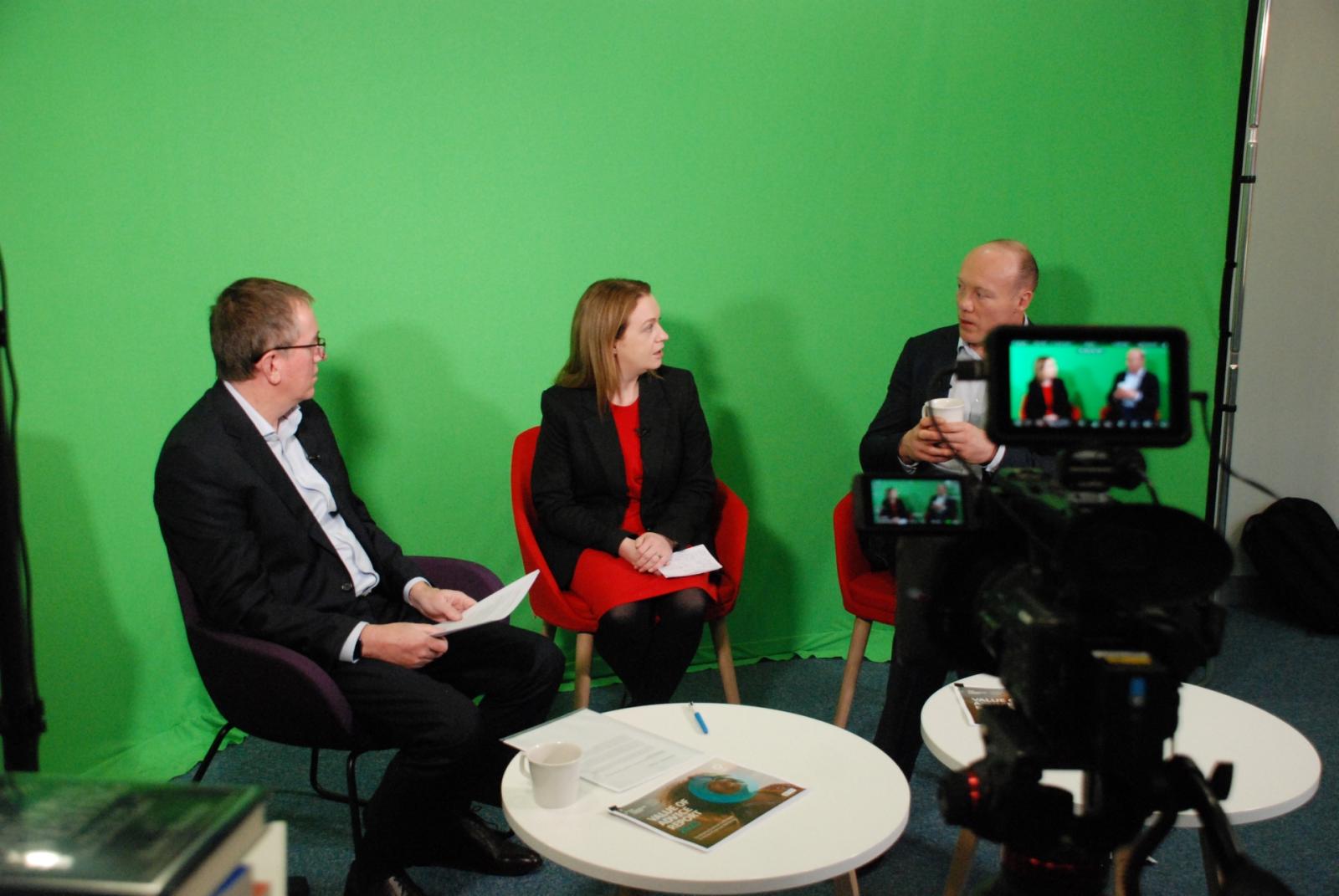
Eamonn Twomey, Rachel McGovern and Anthony Kavanagh.
Eamonn: Anthony back to you, when Rachel spoke about the different forms in which this advice is being delivered to clients. Can you suggest a few practical ways in which financial brokers can take this forward and embed it in their own business.
Anthony: I think that's something financial brokers have been brilliant at over the last 15 years. If you look at the professionalisation of the industry, over that time period education has played a huge part in that.
But it hasn't just been education of advisors, it's been education of clients too and bringing them on that financial literacy journey. And Brokers Ireland has played a huge part in that at a younger level.
But I think where the real skill is taking the theory that advisors have learned through the likes of the CFP course and other areas and making that knowledge available to clients in the language that they understand because people do consume things in different ways.
One of the things that came through in the symposium is about how, as advisors, we need to change and modernise our other communications stream through social media. The TikTok video or the LinkedIn post will be a crucial way of actually transmitting the information and the point across that we're trying to make.
So, taking the theory into the practice has been a real strength over the last number of years of advisors, we just need to up that to include more modern means of communication for younger people through the use of social media.
And not even social media, just whether it's a WhatsApp video note or a voice note, using all means of communication to get those key points across is going to be so important.
Eamonn: Rachel can you give us a sense of maybe some of the challenges that brokers just maybe need to be mindful of?
Rachel: Just in relation to communicating with different generations at the same time, that's going to be a challenge.
Even sitting in a room where you don't know kind of what the family dynamics are, you know, can also be a challenge and I think, you know, making sure that everyone is clear and understands, you know, what the meeting's about, what the objectives are and what they're hoping to get from the actual conversation with the financial broker at the end of it and what to expect because, you know, kind of what we've heard was from a number of different jurisdictions is it can be tricky, you know, some people do not want certain family members in the room or maybe extended family members in the room and that's where I suppose, you know, you need to get, I suppose, agreement from the client and explain to them what way it would work, what would be discussed and what would not be discussed as well is also very important in those settings.
Dynamics is going to be the tricky thing I would think in something like that. But also the communications and how the communication is tailored for different generations.
Maybe for younger generations it's more about simple education, about finances as well, that might be very important for them as opposed to maybe somebody who might be on the verge of maybe taking over a business or succeeding a parent in the business or having wealth transacted or given to them.
One of the points Sheila Cabacungan, Non-Executive Director, Financial Advice Association of Australia, made was around how she pairs different age profiles with different age advisors.
So, for me, if I'm a 55-year-old male working with a 25-year-old female, there could be a gap there and a communication barrier. In Australia, what they've started to do is to take on different age profile advisors and then have a firm planning meeting around how they communicate with those families.
It might mean that you have two advisors working with the one family at different age profiles. It means that you're building those cross-generational relationships and getting the right communication across all parts of the family.
Eamonn: Anthony can you give us a sense maybe how you think clients might react to a Multi-Generational Planning service from a broker?
Anthony: I suppose I can't see any reaction other than a positive one because again the services that financial brokers are providing their clients have increased exponentially over the last number of years.
The industry itself has evolved that the product has moved from being a pension or investment or a life policy to actually the advice being the product and ultimately the pension is an outcome of the advice process.
We're starting to see financial brokers moving into trusted advisor realm of clients. It means that they're not just talking about their pension, they're not just talking about their life savings, they're talking about other goals and wants and needs and they almost become a consultant into the family.
So, anything that can enhance that service and improve that I think is going to be very gladly received by clients.